Choosing between wholesale and retail paper products can make a noticeable difference to a business’s purchasing costs, inventory, and day-to-day operations. While retail buying works well for smaller requirements, wholesale purchasing can offer better value for businesses with regular and higher-volume demand.
But is wholesale always the better option? Not necessarily.
The right choice depends on how much paper your business uses, how frequently you reorder, how much storage space you have, and whether keeping inventory on hand makes financial sense.
In this guide, we compare wholesale vs retail paper products in Saudi Arabia to help businesses choose the most practical option for their needs.
Wholesale vs Retail Paper Products: What Is the Difference?
The main difference is the quantity, pricing structure, and purchasing approach.
Wholesale paper products are generally purchased in larger quantities. Businesses may choose this option when they have predictable demand and want to reduce the cost per unit.
Retail purchasing involves buying smaller quantities as needed. It can be more suitable for businesses with limited storage, occasional requirements, or changing demand.
Neither option is automatically the best. The better choice depends on your business’s purchasing pattern.
Wholesale Paper Products: Pros and Cons
Wholesale purchasing can be particularly useful for businesses that consume paper products regularly.
Benefits of Wholesale Buying
Lower cost per unit
Buying larger quantities can often reduce the effective price per item. This can be valuable for businesses with consistent monthly consumption.
Fewer purchase orders
Instead of repeatedly ordering small quantities, businesses can purchase enough stock to cover their expected requirements for a longer period.
Better inventory planning
Regular users can plan their paper requirements in advance and reduce the risk of running out of essential supplies.
Suitable for larger organizations
Schools, corporate offices, commercial businesses, institutions, and other high-volume users may benefit from wholesale purchasing because their demand is more predictable.
Potential Disadvantages
Wholesale buying also requires careful planning.
- Higher upfront spending
- More storage space required
- Risk of overstocking
- Money tied up in unused inventory
- Less flexibility if product requirements change
For this reason, businesses should calculate expected consumption before placing large orders.
Retail Paper Products: Pros and Cons
Retail purchasing offers more flexibility when a business needs smaller quantities.
Benefits of Retail Buying
Lower upfront spending
Businesses can purchase only what they need instead of committing to a large order.
Less storage required
This can be especially useful for small offices or businesses operating from limited spaces.
Greater flexibility
If your paper requirements change frequently, smaller purchases can help prevent unnecessary stock.
Useful for occasional requirements
Businesses that use certain paper products only occasionally may find retail purchasing more practical.
Potential Disadvantages
Retail purchasing may become less economical when a business repeatedly buys small quantities.
Potential disadvantages include:
- Higher cost per unit
- More frequent ordering
- Increased delivery requirements
- Greater risk of stock shortages
- More time spent managing purchases
Wholesale vs Retail: Which Costs Less?
At first glance, wholesale usually appears cheaper because larger orders often have a lower unit price.
However, the cheapest unit price does not always mean the lowest overall business cost.
Consider two examples.
Example 1: A Large Office
A company with 50 employees may use printer paper, notebooks, envelopes, and other paper products every week.
For this type of business, buying regularly used products in larger quantities can make sense because the inventory is likely to be consumed before it becomes unnecessary.
Example 2: A Small Startup
A small company with a few employees may use relatively little paper.
Buying several cartons simply to obtain a lower unit price could create unnecessary storage requirements and tie up cash.
For this business, smaller purchases may be more practical.
The best purchasing strategy is therefore based on consumption, not simply the lowest advertised price.
Wholesale vs Retail Paper Products: Quick Comparison
| Factor | Wholesale | Retail |
|---|---|---|
| Order quantity | Large | Small |
| Unit cost | Often lower at volume | Usually higher |
| Upfront investment | Higher | Lower |
| Storage requirement | Higher | Lower |
| Ordering frequency | Lower | Higher |
| Best for | Regular, high-volume users | Small or occasional users |
| Inventory planning | Important | Less demanding |
| Flexibility | Lower for large stock | Higher |
| Long-term value | Strong when demand is predictable | Useful when demand is uncertain |
Which Paper Products Can Businesses Buy in Bulk?
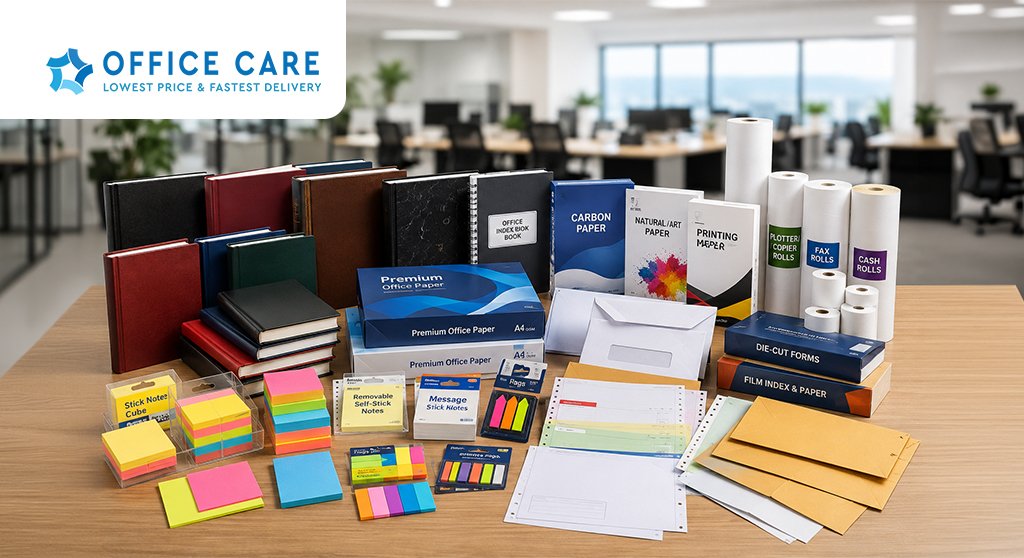
Businesses may purchase many commonly used paper products in larger quantities, including:
- Copy and printer paper
- Writing pads
- Notebooks
- Envelopes
- Continuous paper
- Colored paper
- Filing and document products
- Plotter and copier rolls
- Paper forms
- Other workplace paper essentials
The ideal quantity depends on actual consumption rather than simply buying as much as possible.
What Should You Look for in a Paper Products Supplier?
Choosing the right Paper Products Supplier is just as important as deciding between wholesale and retail purchasing.
Before placing an order, businesses should evaluate several factors.
1. Product Quality
Paper quality can affect printing results, writing performance, durability, and overall user experience.
Always choose products that match the intended application rather than selecting purely on price.
2. Product Availability
A supplier should be able to provide commonly required products consistently. Frequent stock shortages can disrupt business operations.
3. Pricing and Quantity Options
Compare prices based on the quantity you actually need. Ask whether different order volumes have different pricing structures.
4. Delivery and Order Fulfillment
For businesses in Saudi Arabia, reliable delivery is an important part of procurement. Delayed orders can become costly when essential supplies run out.
5. Product Range
A supplier offering a broader range of workplace products can simplify procurement and reduce the need to coordinate with multiple vendors.
6. Business Requirements
A good supplier should understand that businesses may have different requirements based on office size, industry, employee count, and purchasing frequency.
How Office Stationery Fits Into Your Purchasing Strategy
Paper products are rarely purchased alone.
Businesses often need other office stationery supplies, including pens, folders, filing products, notebooks, markers, labels, and writing materials.
When comparing Best Office Stationery Suppliers, businesses should therefore consider more than individual product prices.
A supplier with a broad product range can make recurring procurement easier by allowing businesses to source multiple workplace essentials from one place.
How to Save Money When Buying Paper Products
Whether you choose wholesale or retail, a few simple procurement practices can help control costs.
Track Your Monthly Consumption
Record how much paper your business actually uses each month. This gives you a realistic basis for deciding order quantities.
Buy Frequently Used Products in Larger Quantities
If a product is consistently consumed, purchasing a suitable bulk quantity may reduce the cost per unit.
Avoid Overstocking
Don’t purchase large quantities simply because the unit price is lower. Excess inventory can take up valuable storage space and tie up working capital.
Compare Total Cost
Look beyond the product price. Consider delivery charges, order frequency, storage, replacement, and product quality.
Standardize Common Products
Using consistent specifications for frequently purchased products can simplify procurement and make supplier comparisons easier.
Review Your Purchasing Strategy Regularly
Your business may grow, move offices, add employees, or change its printing requirements. Review your purchasing quantities as your needs change.
Is Wholesale Better for Businesses in Saudi Arabia?
For businesses with regular and predictable paper consumption, wholesale purchasing can often provide better value.
It may be particularly suitable for:
- Large offices
- Schools and educational institutions
- Corporate organizations
- Government and commercial offices
- Retail businesses
- Companies with multiple departments
- Businesses with recurring procurement requirements
However, smaller businesses should not automatically choose wholesale. If consumption is low or unpredictable, retail purchasing may provide greater flexibility.
When Should You Choose Retail Instead?
Retail purchasing can make more sense when:
- Your business uses very little paper
- You have limited storage
- Your requirements change frequently
- You need a small quantity immediately
- You are testing a new product
- You want to avoid holding excess inventory
The goal is not to choose wholesale or retail simply because one sounds cheaper. The goal is to choose the purchasing model that matches your actual business requirements.
Wholesale or Retail: Which Is Better?
The answer depends on your business.
Wholesale is generally better when you have predictable demand, sufficient storage, and regular high-volume requirements.
Retail is generally better when you have smaller or unpredictable requirements, limited storage, or a need for greater purchasing flexibility.
For many businesses, a mixed purchasing strategy can work best. Frequently used products can be purchased in suitable bulk quantities, while less frequently used products can be purchased in smaller amounts.
This approach can help businesses balance cost, inventory, and convenience.
Frequently Asked Questions
Is wholesale paper cheaper than retail paper?
Wholesale paper products can have a lower cost per unit when purchased in larger quantities. However, businesses should compare the total cost and make sure the quantity matches actual consumption.
Is buying paper products in bulk worth it?
Bulk buying can be worthwhile for businesses with consistent demand. It may not be suitable when storage is limited or consumption is unpredictable.
How do I choose a Paper Products Supplier in Saudi Arabia?
Compare product quality, pricing, availability, quantity options, delivery, product range, and supplier reliability before making a decision.
What paper products do offices commonly need?
Common requirements include printer paper, writing pads, notebooks, envelopes, continuous paper, colored paper, filing products, and other workplace paper essentials.
Should a small business buy paper products wholesale?
A small business should consider its actual monthly consumption, storage capacity, and cash flow before choosing wholesale. Smaller businesses may benefit from retail purchasing when demand is low or uncertain.
Wholesale and retail paper products each have their place in business procurement. The best choice depends on how much your business consumes, how often you reorder, how much storage you have, and how carefully you want to manage purchasing costs.
Instead of choosing solely based on the lowest price, businesses should focus on long-term value, product quality, reliable availability, and efficient procurement.
For businesses looking for a dependable Paper Products Supplier in Saudi Arabia, Office Care Trading Est. provides office-related products and supplies to help businesses meet their everyday procurement requirements. Whether you need paper products, office stationery supplies, or other workplace essentials, choosing the right supplier and purchasing quantity can make your procurement more efficient and cost-effective.